Thinking Out Loud

Jim Thornber's Blog

  • About
  • How I became a monk
  • My Book

So, You Want To Be “Spiritual?”

Posted by Jim Thornber on April 9, 2016
Posted in: Christian Spirituality. Tagged: Christian Spirituality, Faith, God, Jesus, Religion, Scripture, Spirituality. Leave a comment

“The eyes of the Lord search the whole earth in order to strengthen those whose hearts are fully committed to him” — 2 Chron. 16:9

spiritual-minuteWhen you hear someone say, “That is a very spiritual person,” what do they mean? I’ve often heard that description used, but when you ask the person who said it what it means, they are often at a loss. I know what it doesn’t mean. To be a “spiritual” person does not mean you walk around silently like some kind of ancient mystic, listening to the quiet breath of God for instructions on what to say and how to pray. It doesn’t mean you’re always ready to say something prophetic and give a word of knowledge and have miracles following you. It doesn’t mean you can quote a thousand different verses on any given subject. Try this for a definition of spirituality: Living your life in harmony with God.

To be spiritual means you make God’s thoughts your thoughts, God’s priorities your priorities. What is important to God is important to you. What burdens God burdens you. When He says, “Go right” you go right, you don’t say, “Why?” A spiritual person decides to follow God knowing that God doesn’t need to explain Himself to anyone. A spiritual person is one whose heart is sensitive to the things of God. 2 Chron. 16:9 says, “The eyes of the Lord search the whole earth in order to strengthen those whose hearts are fully committed to him.” God is looking for men and women who are completely dedicated to Him.

When I think about a spiritual person I think of David, who was completely dedicated to God in every aspect of his very earthly life. And his was a very earthly life. In Psalm 18:29 David says, “With your help I can conquer an army. I can leap over walls with a helping hand from you.” Can you envision a leaping David? Can you see him running, coming to a wall and leaping over it without hesitation and continuing his run? Eugene Peterson describes David as “running toward Goliath, running from Saul, pursuing God, meeting Jonathan, rounding up stray sheep, whatever, but running. And leaping. Certainly not strolling or loitering. David’s is a most exuberant story. Earthy spirituality characterizes his life and accounts for the exuberance. Earthy: down-to-earth, dealing with everydayness, praying while doing the laundry, singing in the snarl of traffic. Spiritual: moved and animated by the Spirit of God and therefore alive to God” (Leaping Over A Wall, pg. 11).

Spirituality means you invite God into your everyday, very ordinary, dull, repetitive sameness and converse with Him about the dullness, the hopes, the dreams, the disappointments and the surprises, the decisions about what to make for dinner and how to pray for a child with cancer. The most spiritual people are the most ordinary people. They aren’t necessarily the religious leaders we see on television, but the unseen housewives and workers we never see up front who are affecting the lives of men and women all over the world without ever getting their names mentioned in Christianity Today or appearing on PTL.

A spiritual person is a man or woman who longs to please God. They know going in that loving God with all their heart, soul, mind and strength is not going to please every one of their friends or all their family. It certainly didn’t please all of David’s brothers. But a spiritual person, although they are concerned with the thoughts of others, do not make what other people think their prime motivation for doing what they do. They know that at the end of their lives they must answer to God, so they look to make their every moment count in the sight of God. And when they fail, which they will (although hopefully, not quite as dramatically as David failed), they turn quickly to God, grieve over their wrongs, and allow His grace and forgiveness to guide their future actions. A spiritual person is an everyday person who chooses to put God first in everything they do.

So, are you ready to be “spiritual?”

Give It Away

Posted by Jim Thornber on March 28, 2016
Posted in: Christian Spirituality, Religion. Tagged: Faith, God, Jesus, Religion, Spirituality. Leave a comment

Pastors, I challenge you to invite your missionaries to take over your Easter service. They are only in the states every few years, and if they are worth supporting they are worth GIVING UP AN EASTER SERVICE! In all their years of serving in missions, my missionaries said WE WERE THE ONLY CHURCH THEY EVER HEARD OF WHO INVITED MISSIONARIES ON EASTER! That is a shame. The resurrection isn’t about us, pastors. I ask you to seriously pray about stepping aside on one of the best attended Sunday’s of the year and letting the limelight shine on your missionary and the great work they are doing.
Now that I am on a roll, let me continue. We send a special Christmas offering to our missionaries. We are one of a very few churches who do. Shame.
We asked our missionaries how we could give to them personally when they come to our church. They expect a special offering going to World Missions, but we wanted to do something for the family. They said they don’t hear that question from other too many other churches. This breaks my heart.
I want my missionaries to share with the best crowd my church will see all year, and that is Easter Sunday. Therefore, unless some other pastor has the nerve to invite them on Easter when they return to the states in three years, I’ve already booked them. And what a blessing to them, and to us, that will be!

Having said that, I believe there are a couple of reasons pastors may not be sharing the pulpit with their missionaries:

  1. It never occured to them and now that they’ve been challenged, they will endeavor to do so.
  2. The missionary they support isn’t good enough to preach at an Easter service. If your missionary cannot connect their missionary calling with the Resurrection of Jesus, you need to support a different missionary.
  3. No matter how much the pastor says they are building the Kingdom of God, they are really building their own “ministry.” This is why they cannot give away the year’s most attended service.
  4. They are hirelings and need to find another vocation.


Can It Be This Simple?

Posted by Jim Thornber on March 5, 2016
Posted in: Christian Spirituality. Tagged: Christian Spirituality, Faith, Jesus, Religion, Scripture, Spirituality. 4 Comments

“He has showed you. O man, what is good. And what does the Lord require of you? To act justly and to love mercy and to walk humbly with your God.” – Micah 6:8


micah-6-8As I have recently turned the half-century mark, I’ve noticed the questions I ask myself are starting to change. When I was in Bible college, I’d ask myself, “What do I want to be when I grow up?” No one is really a grown-up in college, unless you were already married and pursuing a second career. But I was nineteen, so now you understand.

Another key question on all the young minds was, “How can I know God’s will for my life?” In a continual effort to look and sound spiritual, we were very keen to put God in every aspect of our conversation, and this question verily dripped of spirituality (inquiring after God’s Will) and obedience (implying we’d actually follow that Will if we knew what it was. And I did. Mostly.).

However, now that I’m older and a LOT grayer I’m wondering, “Is this it? Is this what God has planned for me all along? A small church in a small Midwestern town with little influence and no retirement fund? Did I miss it somewhere?”

As I was thinking about these things – my education, career moves, influence (or lack thereof), my lack of a will and end of life decisions – I noticed I was asking even smaller questions. Since it is obvious that God hasn’t called me to pastor a megachurch, govern a small nation or write the next great American autobiography, I’m now starting to judge my life not on what I’m going to do, but on how I’m living and what matters most.

Since my Bible college days, the push has been to find my ministry spot (read that, “God’s Will”), get married, raise a family, buy a house, contribute to the 401k, go on missions trips and retire close to the grandkids, hopefully in a warm climate. Well, I got married, found a ministry and helped raise stepsons. Does two and a half out of eight count? In the eyes of the world, am I a success? Probably not.

It’s a good thing I don’t answer to the eyes of the world.

As I was contemplating all these things at work the other day, this one verse in Micah kept rolling around in my head. It was as if God was saying, “This is it, Jim. This is what I’ve called you to do.” And I’m thinking, Can it really be this simple? Have I inhabited the planet successfully if all I’ve done is acted justly, loved mercy and walked humbly before God? I think so.

Now I’m wondering if we all put too much of a burden on ourselves. We want to live the perfect life that pleases a perfect God. We want to raise perfect children who get perfect grades and grow up perfectly healthy so they’ll supply us with perfect grandchildren who will visit us in our perfect retirement home with the perfect golf course.

And what science fiction novel did that idea fall out of?

For all our wants, dreams, hopes, goals, ambitions, work and investments, God has already told us what is good and what He requires. Now I’m wondering why, as I’ve called myself a Christian for almost forty years, I’ve focused on everything else but what God has required.

I wonder how different my perspective would have been if, at age nineteen, my focus was not on finding the right ministry, but on justice, love, mercy and humility before God. And, I wish I had read Micah 6:8 in The Message version in college: “But he’s already made it plain how to live, what to do, what God is looking for in men and women. It’s quite simple: Do what is fair and just to your neighbor, be compassionate and loyal in your love, And don’t take yourself too seriously – take God seriously.” Yes, this is what it means to be a success in God’s eyes. And yes, it is that simple.


Resurrected Blood!

Posted by Jim Thornber on February 12, 2016
Posted in: Christian Spirituality, Religion, Scripture. Tagged: Blood, Christian Spirituality, Faith, God, Jesus, Spirituality. Leave a comment

rugged-crossDid you ever consider how the blood of Christ shed on the Cross at Calvary is still effective in washing away our sins? It is effective due to the fact the blood that cleanses us is resurrected blood! I’m now going to take you on a little Bible study, so if that’s not your cup of tea, you can move over to Pintrest or ESPN….

In 1 John we read, “This is real love—not that we loved God, but that he loved us and sent his Son as a sacrifice to take away our sins.” (4:10). John is pointing us to the value of the death of Christ and the great work that God accomplished for sinners on the cross so that we might become members of God’s family.

The word “sacrifice” in this passage takes us to Leviticus 16 where Israel’s annual rituals that foreshadowed Christ’s sacrifice, and Moses gave instructions to Israel about the Day of Atonement. That day begins by recognizing that we are separated from God and we cannot approach God on own. God reveals His presence to Israel between the cherubim above the Mercy Seat on the Ark of the Covenant, but not even Aaron the high priest can approach God on his own merit or even as the high priest, because all men are sinners and God is holy. God instructed the high priest to kill a goat, whose blood God accepted as providing access to God’s presence, and Aaron placed that blood on the Mercy Seat.

Now let’s move over to the book of Hebrews for further insight. In chapter nine we read that God is still unapproachable, but that Jesus offered His blood as a sacrifice. Heb. 9:11 says, “He entered that greater, more perfect Tabernacle in heaven, which was not made by human hands and is not part of this world.” Just as Aaron the high priest entered into the Tabernacle with blood, Jesus our new High Priest does the same. Verse 12 says, “With his own blood—not the blood of goats and calves—he entered the Most Holy Place once for all time and secured our redemption forever.”

Now, if the blood of bulls and goats could enable Aaron to approach God and stand in front of the Ark of the Covenant, the author of Hebrews goes on in verse 14, “Just think how much more the blood of Christ will purify our consciences from sinful deeds so that we can worship the living God.” So Jesus entered the Tabernacle in Heaven, presented His own blood and secured our redemption forever, cleansing not just our spirit from the evil effect of sin, but also our consciences, freeing us from the guilt and condemnation of our past.

Now, I want to take us one step further. I want you to imagine a Tabernacle in Heaven. It doesn’t matter what it looks like; just think of the most holy place in heaven. This is the place the book of Hebrews just told us Jesus went to with His own blood. Here’s what I want you to consider: When did Jesus enter into this heavenly Tabernacle? We know it was after His death, but exactly when did He do this? I ask because the answer is important to our faith in His blood being able to wash away our sins. There are two clues to when Jesus entered the Tabernacle in heaven, and both are found in John 20.

After His resurrection, Jesus appeared to Mary, who thought He was the gardener – until He said her name! (There may be 10 million people in heaven with your name when you get there, but I guarantee when Jesus says your name, you’ll know He is talking to you!) Then Jesus says, “Don’t cling to me, for I haven’t yet ascended to the Father. But go find my brothers and tell them, ‘I am ascending to my Father and your Father, to my God and your God’” (John 20:17). Jesus didn’t want Mary holding touching Him or holding on to Him because He hadn’t yet seen the Father.

Later in this same chapter Jesus reappears to the disciples, who were cowering behind locked doors, but Thomas was not there. The others tell them that Jesus came to see them and doubting Thomas says, “I won’t believe it unless I see nail wounds in his hands, put my fingers into them, and place my hand into the wound in his side.” (John 20:25). Eight days later Jesus reappears and says to Thomas, “Put your finger here, and look at my hands. Put your hand into the wound in my side. Don’t be faithless any longer. Believe!” (John 20:27). (Mary believed without touching, while Thomas had to touch in order to believe. The point isn’t how you come to believe, but that you DO believe!).

Okay, here are the clues to when Jesus entered into the Tabernacle in heaven. Jesus said to Mary, “Don’t touch me,” but to Thomas Jesus said, “Touch my hands and my side.” Before I really started studying Scripture, I just assumed that after Jesus died He spent some time explaining what He had done to the spirits of the other world, as Eph. 4:7-10 and 1 Peter 3:19 seem to indicate, and then waited out the three days in Heaven. But Jesus told Mary He hadn’t yet ascended to see the Father. Therefore, it was after the resurrection but before He encountered Thomas that Jesus entered into the true Tabernacle in heaven and presented His blood. This means that the blood in heaven is resurrected blood – blood that is powerful enough to overcome all sin and death. The blood that Jesus presented in Heaven has the power to resurrect all of us, for it is fresh and flowing and eternally powerful. Are you grasping the perfection of God’s plan of salvation? Do you see that Jesus didn’t just die, but was also resurrected to present His blood in the Tabernacle in Heaven so that we may all, through the faith in that blood, also have access in the holy presence of God?

Jesus Christ is the One who satisfies God, and the blood of Christ is the basis of that satisfaction, just as the blood of bulls and goats satisfied God in the Old Testament. Now God can stretch out His hand to sinners and invite them into His presence. Furthermore, we must understand that the death of Jesus didn’t change the heart of God, as if God once hated us and now He loves us because of the death of His Son. Instead, the death of Jesus opened the way for the love of God to be poured out and manifested to sinners. The love of God preceded the sacrifice of Jesus; it didn’t follow it. It was only through the sacrifice of Jesus that the full extent of God’s love could be shown to the world. This is how we understand that it is the nature of God to love, and it is the compass of God’s love that directs all our ways.


Humiliated By Service

Posted by Jim Thornber on December 24, 2015
Posted in: Christian Spirituality, Religion. Tagged: Christian Spirituality, Faith, Jesus, Scripture, Spirituality. Leave a comment

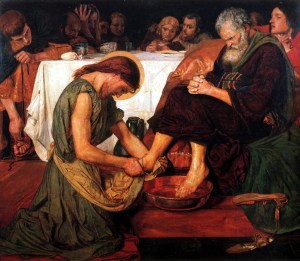
During supper . . . Jesus, knowing that the Father had given all things into his hands . . . rose from supper . . . and began to wash the disciples’ feet and to wipe them with the towel that was wrapped around him. – John 13:2-5 (ESV)


Jesus Washing Peter's Feet -- Ford Madox Brown

Jesus Washing Peter’s Feet — Ford Madox Brown

I have to confess that I’m not a very good servant. Yes, I pastor a church and yes, I’ve been a more-than-less follower of Jesus for almost forty years now, but I still struggle to be an effective servant. I still complain sometimes when I have to go the extra mile, especially when it comes to doing a job someone else is supposed to do.

What started me thinking in this direction is this passage from John. I’m teaching a Bible study on John and after many months, we finally made it to chapter thirteen. And, as has happened many times before, I’m rereading a very familiar passage, a passage I’ve preached on more than once, when something jumps out and grabs hold of my pride – something I didn’t see before.

Foot washing was a very menial task. People went around barefoot or in sandals, and their feet naturally got muddy and dusty. Guests’ feet were usually washed on arrival at the host’s home by a servant, because people didn’t sit at a table to eat but reclined on the floor. This put their feet at the same level with their head. It was a menial job to say the least, but it was also a necessary job.

However none of the disciples, upon arriving at the place Jesus arranged to have the Passover Feast, was willing to stoop to the lowly job of washing the feet of their companions. They may have been hanging out with each other for three years, but no one was going to volunteer to serve the others.

Finally Jesus, in the middle of the meal, gets up and washes their feet. I get the picture that He’s waited as long as He could for one of the boys to understand the true nature of servanthood, and when they don’t, Jesus takes the opportunity to teach them.

How humiliating! Here we have all the personally chosen disciples of Jesus, all too proud to wash each other’s feet, now having their feet washed by their teacher and soon to be Savior. How would you feel if Jesus did something for you that you were too proud to do for someone else? The disciples were too proud to do a necessary job, so Jesus does it for them. No wonder Peter objects (vs. 8). I would too. I’d be embarrassed and ashamed to let Jesus do something I was too proud to do.

I’m sure we’ve all had experiences where a leader we admired shamed us by doing a job we showed ourselves too proud to do. I witnessed a senior pastor washing dishes after a church fellowship while the men on the church board left early. I watched a wealthy business owner wash dirty windows because his too-proud employees didn’t want to be seen doing such a menial task. I know about a bi-vocational pastor who was vacuuming the fellowship hall while retired members of the church watched from their chairs. Maybe it never occurred to them to help. Or maybe they were too embarrassed to do the job they should have volunteered to do in the first place.

Jesus reminds us it is never too late to serve. Jesus got up in the middle of the meal to remind us it is never too late to do what is right. I don’t think Jesus wanted to shame His disciples, but many times we bring that shame upon ourselves. I know I have. I’ve also learned that humility will eliminate shame if I will act in the manner of Christ.

I also know I have the supreme example of servanthood from the one Person I should be serving with all my life. If becoming a man and dying for my sins was not beneath the dignity of God my Savior, then there is nothing in God’s kingdom that is beneath the dignity of me, His servant. It is a lesson I’m learning late in life, but I’m glad to know I’m learning it.


Mary’s “Yes”

Posted by Jim Thornber on December 23, 2015
Posted in: Christian Spirituality, Religion. Tagged: Christian Spirituality, Faith, Jesus, Mary, Religion, Scripture, Spirituality. 1 Comment

“I am the Lord’s servant. May everything you have said about me come true.” – Luke 1:38

Mary 2This is the scene: Some time after the betrothal of Joseph and Mary, but before they   consummated the marriage, the angel Gabriel announced to Mary that God chose her to give birth to the long-awaited Messiah.

This is the question:  “How this is possible, since I’m a virgin?”

This is the answer: “The power of the Most High will overshadow you, so the baby to be born will be called the Son of God.”

This is the consequence: According to the Law in Deut. 22:23-24, death by stoning for adultery. According to Gabriel, the birth of God-with-Us.

This is the response: “I am the Lord’s servant. May everything you have said about me come true.”

This is what bothers me: I don’t know if I would have been as brave as Mary.

Some of you may remember the stigma that once surrounded a girl who was pregnant out of wedlock. Although now in the United States, where more than a million teenage girls get pregnant out of wedlock, Mary’s predicament loses some of its force. However, imagine that the penalty for this infraction is death by stoning, while the girl is claiming to be a virgin and that the Father is the Lord God Almighty. (Now, imagine how Planned Parenthood, the Religious Right and the ACLU would fight over that scenario!)

I also find it interesting that after hearing such a magnificent announcement about bearing the Savior of the world, Mary has something simpler on her mind:  “How this is possible, since I’m a virgin?” It seems that no matter how hard we try, we always filter our faith through the facts. And the fact is this: Mary’s simple acquiescence to the Lord’s request would forever change the life of a poor teenage girl from a backwater town in Israel. It would also change the world.

However, a work of God is a two-edged sword, coming with both great joy and great pain. After considering the repercussions, Mary simply says “Yes” to God. This is one of the things that I really like about Mary: She was the first person to accept Jesus on His own terms, regardless of the personal cost. Mary said, “Be it done according to what you’ve said.” She weighed the knowledge of being an outcast in her home, and chose obedience and submission to God over comfort and acceptability. That should be a challenge to all of us.

Mary also responds with a song that we have come to call The Magnificat. A song like Mary’s comes from a heart that practices praising God—from a life that is faithful to worship God in the good times as well as in the bad times. And this was definitely one of those good times/ bad times events. Being the bearer of the Son of God was going to be a mixed blessing, for with this honor came deep pain and a tremendous responsibility. At the circumcision and consecration of Jesus, Simeon said, “This child is destined to cause the falling and rising of many in Israel” (Luke 2:34). Remember, nothing significant is accomplished for the Kingdom of God without great sacrifice.

But as Mary sacrificed her will and  her body to carry Jesus within her, we now have the same privilege. God has handpicked each one of us to live with the same purpose as Mary – to bring Jesus alive into the world.

God created our bodies to be a home for His Spirit, a sacred vessel through which He makes Himself known to our families, friends, and co-workers, in our homes, in our schools, at our jobs and at the supermarket. Everywhere we go, we take Jesus with us, and so everyday is Christmas in the lives of Christians, giving us the opportunity to bring the world’s greatest gift to whomever we meet, no matter what time of year it is.

I sometimes wonder if I have what it takes to bring Jesus alive into my world. But those God chooses He enables, and with God’s grace I know I can. God offers all of us an invitation to bring the good news of our Savior into the world. How will we respond? A simple “Yes” will do.

Would I Worship or Would I Whine?

Posted by Jim Thornber on November 12, 2015
Posted in: Christian Spirituality, Scripture. Tagged: Christian Spirituality, Faith, God, Jesus, Spirituality, Worship. Leave a comment

“Jesus said to the woman, ‘I was sent only to help God’s lost sheep—the people of Israel.’ But she came and worshiped him, pleading again, ‘Lord, help me!’”­ Matthew 15:24-25


Taize-SilenceA few weeks ago a pastor in my town brought this passage to my attention. It is the story of Jesus leaving Galilee and going north into Tyre and Sidon, which was Gentile territory. A woman who lived there came to Him and pleaded for Jesus to heal her daughter, who was tormented by a demon. As a response to this request, Jesus remained silent.

Today, silence is a most hated concept. With iPods, the internet, radio and television blaring everywhere we go, we’ve learned to distrust the sound of silence. Silence is wrong. Silence means something is broke. Silence makes us wonder if we’re still alive if all we hear is our own breathing.

Add to that silence the fact the people hanging out with Jesus urge Him to send her away and you have an emotional breakdown in the making. But she doesn’t go away. She just stands there and waits for the Son of David to answer her request. And when Jesus does speak, it is not as the meek and mild Jesus we sing about in church.

“I was sent only to help God’s lost sheep—the people of Israel,” He says. Great. Not only is Jesus treating her with silence, now He says he wasn’t sent for her. Apparently, there are people whose needs are greater or better or more deserving than a mother with a child possessed by a demon.

At this point in the story, I’d be ready to tell the Son of David what He can do with His Messiah complex. I mean, if God is going to be so callused as to tell me that others are more deserving of His mercy and grace, then it’s time to find another god.

But what this woman does next just astounds me. Verse 25 says, “But she came and worshiped him.” Is that what I would do? Would I worship God after He has been silent, after the church folk have suggested He send me away and finally after God says He’s not here for me? I’d be more tempted to whine about how life is all against me than to worship a God who intends to ignore me.

But now this woman challenges me again, for in her humility she acknowledges that everything Jesus said was true. She was not an Israelite, Jesus was not here for her first, and she shouldn’t get the meat from the table. All true. It is only the proud people like me who think Jesus’ arrival on earth was all about meeting my personal needs according to my personal timing. When will I learn that even the scraps from God’s table are richer fare than any five-star meal the world has to offer? Isn’t it better to be a dog in God’s kingdom than a king in the realm of Satan? This woman has seen how the demons treat people like her daughter, and she knows there’s more compassion in the crumbs of God than in the lies of the loftiest fallen angel.

Now, let’s look at this passage from another angle. Yes, Jesus was silent, but He was there. He was in her presence and He didn’t leave. In fact, He came to her town; she didn’t travel to him. There is always hope when God is present.

Next, we see that silence isn’t a refusal. He was silent but He didn’t say no. In silence there also is hope. Don’t let the silence of God or the quick answers of the critics send you away from what you need most.

When Jesus replied He was only sent to the lost sheep of Israel, there is still hope. For if that was true, what was Jesus doing in Gentile territory? Sometimes we think God is only going to help the good people who are worthy. But this scene reminds us that God came to save the world, because the entire world is as unworthy as this Gentile woman. God is increasing her faith – and that is something we could all use a bit more of.

So, the next time God is silent to my requests, I need to remember that His silence doesn’t always mean “No.” I need to remember that Jesus came to me before I came to Jesus, for that reminds me how important I am to Him. I need to remember that the critics who want me to disappear have forgotten that Jesus chose to be with me, and I’ll stand in His presence as long as He’ll have me.

Finally, when God tells me the truth about who I am, I need to remember that even a mutt like me has a place at the Banquet table of God. Sure, life may not always go as I’d like it, but Jesus has entered the room and where He is, there is hope.


No More Souvenirs

Posted by Jim Thornber on September 30, 2015
Posted in: Christian Spirituality, Scripture. Tagged: Christian Spirituality, Faith, God, Jesus, Scripture, Spirituality. 2 Comments

“This world is fading away, along with everything that people crave. But anyone who does what pleases God will live forever.”­ – 1 John 2:17

souvenirs 1            I was listening to the radio yesterday while I was painting the bedroom and a story came on about Donald Parrish, the number one ranked traveler on the Most Traveled People list. Not only has Donald visited all 193 UN member states, Parrish has been to almost every geographic subdivision in every major country: all 50 US states; 27 regions of France; 32 Chinese provinces; 83 Russian political subdivisions; 28 Indian states; 23 Argentine provinces; 16 German Länder; 20 regions of Italy; all 19 autonomous communities in Spain, and more. This guy is definitely not a homebody.

I don’t know what Donald did before he retired, but he says he’s not rich. To prove the point he points to a 15-year-old Acura with more than 140,000 miles on it. “Some people spend their money on nice clothes and fancy cars,” he said. “I spend my money on travel.” The radio story ended by saying Donald doesn’t spend his money on souvenirs, either, for then he’d have to buy a house to hold all his stuff.

At that point I went into the other room and started writing down some notes and wondering about the timing of God.

I’ve been teaching a series in my church on 1 John and I just finished my fifth installment called, “Falling Out Of Love” (1 John 2:12-17). One of my points is that we must fall out of love with the things of this world because this world is fading away along with everything that people crave. So this idea is on my mind when I hear that Parrish doesn’t buy souvenirs because then he’d have to buy a house to store them.

So here’s what’s bothering me and I share it with you: In what ways are we obsessing over and spending money on things we can’t take home? Not the home we live in; the home we’re going to. Heb. 11:13 says we’re strangers and pilgrims on earth. Heb. 13:14 reminds us “this world is not our permanent home; we are looking forward to a home yet to come.” So why is it we spend so much time desiring things that will not last?

I’m not saying that “things” in this world are all useless. I’m very grateful for clean socks, a comfortable bed, coffee pots, cell phones and a jacket in the winter. I spend hours in our flower garden and, as mentioned above, paint bedrooms that I know I won’t always own. I guess the main question I need to ask myself is, “Am I putting as much time into my heavenly dwelling as I am in storing up treasures on earth?” I’ve got hundreds and hundreds of books on my shelves that I will never read again. I’ve got clothes in my closets I haven’t worn in years. I’ve got drawers stuffed with mementos of things I can hardly remember. And I’ve got a house to hold all the souvenirs of the places I’ve been, whether its college thirty years ago or the used book store last week.

I want to be remembered for my character, not for my collections. I don’t need any more souvenirs, and I don’t need a bigger house to store more unused stuff. When I hear God say “Well done!” I want it to be for my ability to obey His will rather than my obsession over things I think I must have. I need to spend more time concentrating on pleasing God than I do collecting one more knick-knack that will sit on a shelf, gather dust and one day fade away.

That’s where I’m at today. How about you?


God Left Me Alone

Posted by Jim Thornber on September 5, 2015
Posted in: Christian Spirituality. Tagged: Christian Spirituality, Faith, God, Jesus, Religion, Scripture, Spirituality. Leave a comment

“God withdrew from Hezekiah in order to test him and to see what was really in his heart.”

2 Chron. 32:31


alone_960_3I know this is hard to believe, but sometimes I’ve felt very alone in the world.

Shocking, isn’t it? Here I am, a pastor of a church and a man whose been going to church for 40 years. I’m a self-proclaimed normal and sane person who believes I can actually talk with God and, at times, believes God even talks back.

Yet, sometimes I’ve felt there was no one listening, that God was not in the room much less in the universe, and I was the only real person in the world with feelings, hurts, disappointments, desires, lusts, dreams, failures, successes and more questions than answers.

Then I read about King Hezekiah, and I began to understand that I’m not the first person who ever felt he was alone in the world. And this was after Hezekiah had a great encounter with the miracle-making God. It went like this.

One day Hezekiah wakes up from a nap and isn’t feeling well. His buddy Isaiah, a local prophet, tells him to get his affairs in order for he was going to die. King Hezzy cries out to God and God sends Isaiah back to the King with good news: he is going to live!

When you read the story in 2 Kings 20, you see God promised He would heal Hezekiah of a life-threatening disease and proved it by making the shadow go back ten steps on the stairway. This is very heady stuff.

Word of this miraculous series of events draws international attention and foreign ambassadors come to pay their respects and see how the king is doing. Now God, knowing Hezekiah had a tendency to become proud (2 Chron. 32:25), decided to test the king. He withdraws His presence to see if he’s going to tell the ambassadors about God’s goodness and lovingkindness, or if Hezekiah is going to show them all his accomplishments as a king. Hezekiah failed the test by showing his visitors everything in his storehouses (2 Kings 20:13).

This is where I pause, because I completely understand Hezekiah. Continue Reading

Scriptures That Bother Me — John 7:24

Posted by Jim Thornber on August 28, 2015
Posted in: Christian Spirituality, Scripture. Tagged: Christian Spirituality, God, Jesus, Scripture, Spirituality. 1 Comment

“Stop judging by mere appearances, and make a right judgment” – John 7:24


JudgeI was driving home from church the other morning when I noticed something in the road. The car in front of me swerved to miss the item, and when I got closer, I could see it was a large cardboard box. For some weird reason, I got this noble idea to pull into a nearby parking lot, go out onto the busy street, dodge some early morning traffic and get the box out of the road. If people continued to swerve to avoid the box, sooner than later it was going to cause an accident.

As I headed into the street, I noticed a car slowing down to let me get the box. At first I thought, What a nice man to slow down. Then this thought quickly entered my head: I bet this driver thinks I’m the one who lost the box. Little does he know I’m actually the one doing the good deed.

Here I was just trying to do the right thing and STILL my ego wants somebody to see me and say, “Hey! What a nice, gray-haired man to get that box out of the street. Hope he lives.” Or some such thing. I wanted to be known for the good I was doing, not be judged for being the one who littered the highway.

Now my mind was really kicking into gear. First, how do I know that driver was judging me for littering? I don’t. I figured he was thinking about me what I’d be thinking about someone else if I drove up on a scene where a middle-aged maniac was dodging traffic to save the life of an abandoned cardboard box.

Self-Help Thought # 1: I need to quit trying to guess what other people are thinking about me. Besides, do I really want to know everything people are thinking? No, probably not.

Self-Help Thought # 2: I wonder how many times I judge a scene without all the facts. Just as other drivers may have seen me as the loser (of the box) without knowing my motives, I’ve often viewed others as the culprit in a situation because I didn’t have all the information.

This is why Jesus’ words in John 7:24 hit me so hard: I have often done the very thing He warned us to avoid.

For example: Remember that husband and wife having a low-voiced, intense discussion? Are they arguing because he said something selfish, or are they trying to figure out how to bless a family in the church and still have enough money to pay their rent?

See that man coming out of the bar? Has he been drinking away his paycheck, or did his mom call him to see if he could talk his dad into coming home?

Or that nut in the middle of the street picking up trash. . . .you get the picture.

That’s a lot of mental gymnastics for one morning, but it was a caution to me not to judge a person or a situation too quickly without knowing all the facts. Hopefully, I won’t have to risk my life next time just to learn a simple lesson.

Posts navigation

← Older Entries
Newer Entries →
  • My Book

    If you want to purchase a copy of my book, click the image.

    This book tells of the lessons I learned as an Assemblies of God minister who was also a monk. For four years I lived with the Brothers and Sister of Charity at the Little Portion Hermitage. I went there because I thought it was unique and would make my spiritual life comfortable. God showed me I had to take off my comfortable clothes and put on the clothes of Christ. You can click the image to learn more and purchase the book.

  • December 2025
    S M T W T F S
     123456
    78910111213
    14151617181920
    21222324252627
    28293031  
    « Apr    
  • Archives

    • April 2024
    • September 2023
    • October 2022
    • September 2021
    • August 2021
    • July 2021
    • May 2021
    • November 2020
    • October 2020
    • September 2020
    • July 2020
    • June 2020
    • March 2020
    • February 2020
    • December 2019
    • November 2019
    • August 2019
    • July 2019
    • June 2019
    • February 2019
    • December 2018
    • October 2018
    • September 2018
    • August 2018
    • July 2018
    • June 2018
    • May 2018
    • April 2018
    • March 2018
    • December 2017
    • November 2017
    • October 2017
    • August 2017
    • July 2017
    • June 2017
    • May 2017
    • April 2017
    • March 2017
    • February 2017
    • January 2017
    • December 2016
    • November 2016
    • September 2016
    • August 2016
    • July 2016
    • June 2016
    • May 2016
    • April 2016
    • March 2016
    • February 2016
    • December 2015
    • November 2015
    • September 2015
    • August 2015
    • July 2015
    • June 2015
    • May 2015
    • April 2015
    • March 2015
    • February 2015
    • January 2015
    • December 2014
    • November 2014
    • October 2014
    • September 2014
    • August 2014
    • July 2014
    • June 2014
    • May 2014
    • April 2014
    • March 2014
    • February 2014
    • January 2014
    • December 2013
    • November 2013
    • October 2013
    • September 2013
    • August 2013
    • July 2013
    • June 2013
    • May 2013
    • April 2013
    • March 2013
    • February 2013
    • January 2013
    • December 2012
    • November 2012
    • October 2012
    • September 2012
    • August 2012
    • July 2012
    • June 2012
    • May 2012
    • April 2012
    • March 2012
    • February 2012
    • January 2012
    • December 2011
    • November 2011
    • October 2011
    • September 2011
    • August 2011
    • July 2011
    • June 2011
    • May 2011
    • April 2011
    • March 2011
    • February 2011
    • January 2011
    • December 2010
    • November 2010
    • October 2010
    • September 2010
    • August 2010
    • July 2010
    • June 2010
    • May 2010
    • April 2010
    • March 2010
    • February 2010
    • January 2010
    • December 2009
    • November 2009
    • October 2009
    • September 2009
    • August 2009
    • July 2009
    • June 2009
    • May 2009
    • April 2009
    • March 2009
    • February 2009
    • January 2009
    • December 2008
    • November 2008
    • October 2008
  • Blogroll

    • Archie
    • bbgcmac
    • Bellissimanh
    • Beth Sciallo
    • Brothers And Sisters of Charity
    • George Cannon
    • internet monk
    • Kin Robles
    • natalie spera
  • Recent Posts

    • An Abundance to Give
    • Why Jesus Christ Is NOT My Personal Lord and Savior
    • Thank You For Saying, “Thank You”
    • The Day My Grandmother Talked To Me About Sex
    • A Lesson in Love
  • Recent Comments

    Henry Andrews's avatarHenry Andrews on Our Four-Minute Fling in First…
    Jim Thornber's avatarJim Thornber on Scriptures That Bother Me…
    Nicole's avatarNicole on Scriptures That Bother Me…
    Eva's avatarEva on When God is Silent
    Rosemary Q's avatarRosemary Q on A Poor Widow’s Rich Offer…
  • Pages

    • About
    • How I became a monk
    • My Book
  • RSS Thinking Out Loud

    • An Abundance to Give
    • Why Jesus Christ Is NOT My Personal Lord and Savior
    • Thank You For Saying, “Thank You”
    • The Day My Grandmother Talked To Me About Sex
    • A Lesson in Love
    • God Doesn’t Owe Me An Apology
    • No Wishing Allowed
    • This Is NOT My Money
    • Comfort Is Not The Agenda
    • Going Where Others Cannot
  • Abraham alone Apostle Paul Assemblies of God Blood Brothers and Sisters of Charity Calvary Cancer Catholic Catholicism Cats Character Christianity Christian Spirituality Christmas Church Colossians Community Living Compassion Confession Death Demons Disciples Divorce Ecumenism Exodus Faith Forgiveness Galatians Genesis Gifts Giving God Gratitude Heaven Hebrews International Pentecostal Holiness Church James Jesus Job John Michael Talbot Joy Leadership Little Portion Love Luke Mark Twain Marriage Mary Matthew Miracles monasticism Money Monk Moses Music Noah Obedience Oswald Chambers Pastor prayer Prodigal Son Publishing Religion Romans Salvation Savior Scripture Service Soccer Solomon Spiritual Gifts Spirituality Worship Writing
  • Top Posts

    • Scriptures That Bother Me -- Matthew 14:28-30
    • What Martial Arts Taught Me about Prayer
    • Why Jesus Christ Is NOT My Personal Lord and Savior
    • Scriptures That Bother Me -- 2 Chronicles 32:31
    • The Day My Grandmother Talked To Me About Sex
    • Scriptures That Bother Me -- Deuteronomy 8:10
    • Scriptures That Bother Me -- Luke 15:11-24
    • Scriptures That Bother Me -- Luke 2:36-37
  • Meta

    • Create account
    • Log in
    • Entries feed
    • Comments feed
    • WordPress.com
Create a free website or blog at WordPress.com.
Thinking Out Loud
Blog at WordPress.com.
Privacy & Cookies: This site uses cookies. By continuing to use this website, you agree to their use.
To find out more, including how to control cookies, see here: Cookie Policy
  • Subscribe Subscribed
    • Thinking Out Loud
    • Join 260 other subscribers
    • Already have a WordPress.com account? Log in now.
    • Thinking Out Loud
    • Subscribe Subscribed
    • Sign up
    • Log in
    • Report this content
    • View site in Reader
    • Manage subscriptions
    • Collapse this bar
 

Loading Comments...