Thinking Out Loud

Jim Thornber's Blog

  • About
  • How I became a monk
  • My Book

An Abundance to Give

Posted by Jim Thornber on April 24, 2024
Posted in: Christian Spirituality, Religion, Scripture. Tagged: Faith, God, Jesus, Spirituality. 1 Comment

For the past few weeks, I have been teaching about the Feasts of Israel as listed in Leviticus 23. Last Sunday morning at Journey Church, I started a two-part study of the Feast of Tabernacles, or Sukkot. 

When I read Leviticus 23:33-44 in front of my church, I skipped verses 37-38 because many scholars consider these verses to be a type of parenthesis within the text. In fact, the New International Version and the New Living Translation put these verses in parenthesis, and I wasn’t even going to mention them.

However, one morning something prompted me to read them closely and consider why these verses interrupt the narrative about the Feast.  Verse 37 says the people presented “special gifts to the Lord—burnt offerings, grain offerings, sacrifices, and liquid offerings—each on its proper day.” Then Moses writes, “These festivals must be observed in addition to the LORD’S regular Sabbath days, and the offerings are in addition to your personal gifts, the offerings you give to fulfill your vows, and the voluntary offerings you present to the LORD” (Lev. 23:38).

As I considered why these verses seem to interrupt the narrative, I remembered God also instructed Israel to take a Sabbath year (Ex. 23:10-11), and my mind began to race! Israel, unique among all the nations of the world, had the blessed opportunity to trust God on such a grand scale they would astound other nations and show, without a doubt, the generosity of the LORD who cares for His people in miraculous ways—if they would only trust Him.

When you read about the festivals, you encounter so many different types of offerings you can’t keep track of them in your head. Then, as we just read, the gifts, sacrifices, and offerings that are unique to each Feast are in addition to the regular offerings and, if that isn’t enough offering, you can also include personal gifts and voluntary offerings. It was then I began to wonder, “With all these offerings given to the LORD, what’s left to eat?”

What we have trouble understanding is the sheer abundance of produce that can be grown and harvested in the Promised Land—a land the people didn’t possess when Moses wrote God’s instructions. However, God has repeated His instructions to “Trust Me” to every successive generation since Adam and Eve, reminding us to give and it will be given back, pressed down, shaken together and poured into our lap (Luke 6:38). While hearing about all the different gifts and sacrifices God required, the Israelites could have complained and said, “Wow, does God want a lot from us!” Or, they could have rejoiced and said, “Wow, do we ever have an abundance to give God, and we still have an abundance left over!”

 “Trust Me,” God was saying, and take off one day in seven, one year in seven, and a year following seven weeks of years. Don’t work. Don’t plant. Don’t store. Don’t do “normal.” Allow alternative thinking, experiences, hopes, anticipations, conversations, and observances to take place when you don’t work for a year and trust God to take care of you for three, without ever failing to provide for all the sacrifices and offerings God described. God wanted Israel to trust His story as He was writing it and while they watched it play out among the nations around them. What a wonderful opportunity that was, but they wouldn’t do it. And in so many ways, neither do we.

But we could.

Think about the ways God wants to provide for us, but in our fear, we don’t let Him. We work things out on our own and never see God provide for us in the seventh year because we don’t trust Him.   

A while back, I asked God why I keep doing the things I don’t want to do. Why do I keep entertaining my doubts, or keep having that same conversation in my head as I justify my actions towards someone who hasn’t even thought about me? Why do I stay angry with people who are completely unaware of my hurt or worse, are no longer alive? Why do I desire a relationship I cannot have or deny a relationship I should be giving? Why do I worry about money and retirement and if I’m still doing enough in the world to please God and still fool my neighbor into thinking I’m a nicer guy than really I am? Can I get a witness?

Why, God? Why do I keep doing the things I don’t want to do? And God’s answer? Because you believe your desires are more important than My provision.

Perhaps that is the reason for Israel’s failure to keep all the feasts, to observe a Sabbath year, to trust God as a nation when the doubts began to rise and the powerful nations around them seem to be succeeding where they are failing. Like Israel, I’m prone to take my eyes off the Lord God our Creator and focus them on my circumstances, my fears of not having enough, and my doubts that override my faith.

Then again, one of the beautiful things committed Christians all have in common is our ability to recognize our doubts about God and life, admit them, then turn to God and seek His help. Why would we seek God? Because He invited us to seek Him. Jesus said, “Come to me, all who are weary and burdened, and I will give you rest” (Matt. 11:28). However, I really like the way Eugene Peterson phrases it in The Message.

“Are you tired? Worn out? Burned out on religion? Come to me. Get away with me and you’ll recover your life. I’ll show you how to take a real rest. Walk with me and work with me—watch how I do it. Learn the unforced rhythms of grace. I won’t lay anything heavy or ill-fitting on you. Keep company with me and you’ll learn to live freely and lightly” (Matt. 11:28-30).

Perhaps it is time for the true disciples of Christ to move on from saying, “Wow, does God want a lot from me,” and begin saying, “Wow, do I ever have an abundance to give to God, and I still have an abundance left over!”

Why Jesus Christ Is NOT My Personal Lord and Savior

Posted by Jim Thornber on September 26, 2023
Posted in: Christian Spirituality, Church, Scripture. Tagged: Christian Spirituality, Church, Faith, God, Jesus. Leave a comment

One of the most disconcerting statements ever conceived by a misguided Christian is the one that says, “Jesus Christ is my personal Lord and Savior.” I must take issue with this statement for a number of reasons.

First, this phrase is not found anywhere in Scripture. True, the word “Trinity” isn’t in Scripture either, but there is evidence for the “Trinity,” where there is no evidence Jesus is a personal Lord and Savior.

Second, although it is good for a person to acknowledge that Jesus is their Lord and Savior, too often the emphasis is on the word “personal” instead of “Lord.” If Jesus is my personal Lord and Savior, then I’ll have the tendency to live as if Jesus is my Lord and my relationship with Him does not necessarily include you. This idea has led some Christians to tell me their relationship with Christ is such a personal matter they choose not to share it with others. The next unfortunate step in this thinking is that since they have a personal relationship with Jesus, they don’t need the rest of the Body of Christ. They don’t need the fellowship, strength, encouragement, and growth that comes when people gather in the company of other believers for teaching, fellowship, communion, and prayer, because they “have a personal relationship with Jesus.”

Paul said, “Above all, you must live as citizens of heaven, conducting yourselves in a manner worthy of the Good News about Christ” (Phil 1:27). Some believers have forgotten they are members of a Christian community. They forget they are citizens of heaven and have responsibilities not just to that heavenly country, but also to the other citizens of that country. Furthermore, any Christian who considers their “rights” as an American (or Canadian, or Japanese, or Nigerian, etc.) as taking precedence over the needs of the Kingdom, has not only misunderstood what it means to be a grateful citizen of heaven, but have discounted the price paid for their citizenship and may have forgotten to look forward “to the city with foundations, whose architect and builder is God” (Heb. 11:10). They’ve lost concern for the other citizens of heaven and neglected the gifts and spiritual insights that other Christians can provide. They begin to believe their thoughts are God’s thoughts and don’t want the local fellowship to tell them any differently.  

1 Peter 1:16 says, “For the Scriptures say, ‘You must be holy because I am holy,’” and I appreciate that many Christians use that verse as reminder of the ways they are to conduct their lives. But too often they consider holiness only in terms of what it can do for them, such as bringing them eternal life or peace of mind and soul, but they forget Peter wasn’t addressing an individual, but “God’s chosen people”(1:1). They don’t consider that a primary purpose of living a holy life is to “…show sincere love to each other as brothers and sisters. Love each other deeply with all your heart”(1:22). James Boice writes, “Knowing ourselves to be members of a living community of which Jesus Christ is head and being conscious of our common life together, you and I are to live lives worthy of our calling. We are to live as Christians. We are to live as members of Christ’s body.” (Philippians, pg. 102).

 Another consequence of claiming Jesus as our personal Lord is Savior is it can turn a local congregation into a “Bless Me” club. As a teacher of Scripture and pastor of a congregation, I refuse to spend most of my time in the pulpit soothing the saved and reassuring the redeemed. Consequently, many have moved on to other fellowships to have their feelings massaged. My vision as pastor is to help Journey Church become a place where hurting people can find healing, abused people can find safety, hypocrites can find sincerity, and spiritually hungry people can find eternal fullness in the Word of God and the fellowship of the saints. I want Journey Church to realize that nobody here is better than anyone else, that we are all saved by grace and not by our merits, and that once we are here, our continuing mission is to reach out to other hurting people like ourselves and invite them into the tender, loving, saving arms of our Risen Lord.

This is why I say Jesus Christ is not my personal Lord and Savior: He is OUR Lord and Savior. The difference between those two ways of thinking is the difference between a kingdom of one and the Kingdom of Heaven. Now truly, which Kingdom would you rather live in?

Thank You For Saying, “Thank You”

Posted by Jim Thornber on October 27, 2022
Posted in: Christian Spirituality, Grief, Scripture. Tagged: God, Gratitude, Jesus, Scripture, Spirituality. Leave a comment

          On Mother’s Day this year, just before I headed for the piano at church to practice with the worship team, my phone “binged,” alerting me I received a text on Facebook Messenger. I didn’t immediately recognize the name “Bailey,” but there was something vaguely familiar in the last name. This person asked if I was the same Jim Thornber who used to live in California, taught about the physical aspects of the crucifixion of Christ at a Bible study, and who later moved to Arkansas. Yep, that would be me.

            As we continued to message, they said they wanted to contact me for two reasons. First, they wanted me to know that my sharing the Gospel with them was not a wasted effort. Although they didn’t accept Jesus as their Lord when I lived in California, they eventually did and have been a strong Christian for many years. Second, they wanted to say, “Thank you” for never giving up on them and having so much patience as they asked “so many questions.” As a bonus, I gained an old/new friend in my life, and I still like to say to Bailey, “Thank you for saying, ‘Thank you.’”

            Last Sunday evening I received another “Thank you.” Johanna is a student at Southwestern Christian University, and heard me speak at the chapel in September. The theme of this semester’s chapel is “Lessons from the Dead,” so I read three chapters from my book Better with Every Breath, which shares some of the lessons I learned since my wife Barbara passed away in September, 2020. Johanna shared with me she is now putting up Post-It notes in her dorm room to remind her to ”choose joy,” which is a reference to one of the chapters I read. I told Johanna I was now crying, and thanked her for saying, “Thank you.”

            As I was thinking about these two people who recently said “Thank you” for my influence in their life, my mind wandered over to Galatians 6:6, which says, “Those who are taught in the word of God should provide for their teachers, sharing all good things with them” (NLT). Although this verse may lean primarily towards providing finances for those who are teachers of the Word, there is another provision I’m thinking of today which cannot be purchased, and that is gratitude.

            I understand how satisfying (and humbling!) it was when Bailey and Johanna said, “Thank you.” Now, in the two years since Barbara passed away, another lesson I’ve learned is to make a greater effort to express my gratitude to the people in my life while I still have them, for that hasn’t always been the case.  Gratitude is such a great gift, and it only takes a moment to express my sincere thankfulness and appreciation to my mentors, teachers, and friends for the significant ways they have touched my life.  It doesn’t cost us anything to say “Thank you,” and it is a gift anyone can give.

            Finally, I like to remind myself that gratitude is a gift that gives twice. First, by sharing my gratitude with someone who has touched my life, it gives them a gift they cannot buy and, if they are anything like me, the effects will linger long after the words have been spoken. Second, gratitude increases my own joy and happiness, for it reminds me of all the treasures in my life money cannot buy. I’ve come to realize that I own only those things that cannot be taken from me, with gratitude and joy being at the top of that list.

            May we all learn to be better givers and receivers in that beautiful exchange of gifts that says, “Thank you for saying, ‘Thank you.’” 

The Day My Grandmother Talked To Me About Sex

Posted by Jim Thornber on September 2, 2021
Posted in: Christian Spirituality, Marriage, Scripture, Sex. Tagged: Faith, God, Marriage, Scripture, Sex. Leave a comment

 “The man and his wife were both naked, but they felt no shame.” (Gen. 2:25)  

             One day in 1979, I was visiting my grandmother at her apartment in Oswego, New York. Not known for her subtly nor her bashfulness, Rosemary, as we all called my dad’s mom, turned to me and asked, “Jim, have you had sex yet?” Naturally, I didn’t see that question coming from my grandmother, but I wasn’t surprised.

            I confessed that I had not had sex. I was an eighteen-year-old virgin who had been a Christian since I was twelve. Of course, I didn’t lack opportunities to have sex; what I lacked was courage. I didn’t have the courage to do something I believed the Bible said not to do. I’d spent six years in various youth groups where relationships were discussed, and the overwhelming biblical consensus was that a man and a woman should wait until they are married before they engage in sexual intercourse. I didn’t tell Rosemary all that. I simply said, “No.”

            This is where the conversation got even weirder than it already was, as hard as that is to imagine. Rosemary went on to tell me about her wedding night experience with my grandfather. She told me she was a virgin on their wedding night but my grandfather was not, which was not unusual in the 1930’s. At this point I’m thinking, “This is too much information,” but Rosemary continued unabashed.

            “The first time a woman makes love can be a very difficult and scary time for her. She needs a man who has enough sexual experience to be gentile with her on her first night. Your grandfather was such a man, and I’m grateful.”

            As I’m contemplating all this, Rosemary continues. “I suggest you find yourself an experienced woman who can teach you the art of lovemaking, so when it is time for you to be with your wife for her first time, you can lead her gently and satisfy her needs.”

            Yes, my fifty-five year old grandmother just told her eighteen-year-old grandson to go out and have sex.  

            It’s not that I hadn’t thought about having sex. After all, I was EIGHTEEN!!  Of course, I’d thought about it. Often. God created me to desire a woman, to want to make love, to “be fruitful and multiply,” as Genesis 1:28 says. It was perfectly natural for me to want to lie down with a woman and experience sexual intercourse, and now my grandmother had just strongly suggested I go out and fulfill that desire.

            As you can imagine, this conversation had my head spinning for about a week. As an eighteen-year-old virgin, I was doing my best to keep my thoughts pure and not think too much about sex, but now my grandmother suggested I do just the opposite. And yes, there was a part of me who thought she was giving me very good advice, and I spent considerable time thinking about how I could get away with it.

            But that was the problem. I didn’t want to “get away” with anything. My grandmother said a man should not be a virgin on his wedding night, but my mind kept going back to the first chapter of Genesis, which reveals God’s original plan for a man and a woman. In this creation account, we see one man and one woman who were both virgins upon their first sexual experience and, in spite of their inexperience, they managed to stay together for a long and fruitful life.

            Furthermore, I considered two other items in addition to what I believed the Bible taught me about sex. First, I didn’t want my sexual abilities, or lack thereof, to be the topic of conversation among other women I may have known in town. That discussion should be a private conversation between a husband and wife. Second, as cute as he may have been, I didn’t want a little Jimmy running around as a result of my poor decision. I wanted to go to Bible College, and the shame I would have felt because of my disobedience to God resulting in an unwanted pregnancy might have derailed that dream.

            Rosemary and I never talked about it again, so I never told her I rejected her advice. My first real crisis regarding my obedience to Scripture came through the caring, yet misguided, advice from my grandmother. I loved her dearly, of course, but I decided my obedience to God’s Word was more important than either my grandmother’s advice or the natural desires of my body. And this was how, fifteen years later, I was able to share my virginity with my wife on our wedding night, where “the man (me) and his wife (Barbara) were both naked, but they felt no shame” (Gen. 2:25).

A Lesson in Love

Posted by Jim Thornber on August 20, 2021
Posted in: Christian Spirituality, Grief, Marriage, Service. Tagged: Faith, Flowers, God, Grief. 4 Comments

“Each of you should look not only to your own interests, but also to the interests of others.” (Phil 2:4)

            Back in the early spring, I decided it was time to put together a list of the flowers and plants I wanted to buy for the dozen or so pots around the house that were awaiting a splash of color after a cold, Kansas winter. Barbara was the mastermind of our flower gardens, but with her passing last year, the job now fell to me.

I knew the basic plants and flowers I wanted to get: Coleus and petunia, dragon wing begonia and purslane, dahlia, geranium, caladium and impatiens. With this list in my head and an excitement I hadn’t felt in months, I drove to the local nursery close to my house.

However, as I entered the parking lot of the nursery, sadness entered the cab of my truck. I tried to ignore it, but as I walked up and down the aisles looking at all the plants that reminded me of Barbara, I started to cry and knew I couldn’t do it. Fortunately, I had the greenhouse to myself, so nobody saw a sixty-year-old man blubbering his way out the door and back to his truck.

            After a few tearful minutes in my truck, I wiped my face, went back into the nursery and bought four items for the front of my church. I counted that as a victory.

            When I got home, I sent a text to two friends who had lost their spouses before I lost Barb, telling them what happened and that I planned to try again next week. One friend responded, “Oh….take your time. You will know when, even if just a couple of pots this year.” The other said, “Or maybe not next week…maybe next month or next spring. There is no timetable—you’ll know when you’re ready.”

            A few weeks after my breakdown at the nursery, I was talking Lauren, a single girl who lives across the street. She was struggling to keep her plants alive so I was giving her some tips. Because she had plants on her porch and I didn’t, I mentioned to her my failure at the nursery as a way of explanation for the lack of plants and flowers. Lauren said, “Oh, I understand. But I always enjoyed looking across the street and seeing all the flowers and the color.”

            She didn’t know it then, but that was the boost I needed. The next day I went back to the nursery and stocked up on the plants and flowers I tried to buy three weeks ago. When I got home, I took a picture of everything in the back of my car. Then I sent the picture to the friends I texted earlier with a caption that said, “SUCCESS!”

            The lesson I learned from this was simple: I shouldn’t stop doing things that bring other people pleasure just because my feelings are hurt. Yes, I wanted to buy flowers. Yes, I got emotional about it. Yes, I waited a while before I went back, but I DID go back. Lauren taught me how some of the simple habits Barbara and I formed also brought simple pleasures to other people. Paul reminded the Philippians to look out for “the interest of others.” Lauren’s offhand remark reminded me she was one of the “others,” and now I wonder how many “others” are out there who might need me to attend to the things that bring joy not just to me, but also to them.    

God Doesn’t Owe Me An Apology

Posted by Jim Thornber on July 5, 2021
Posted in: Christian Spirituality, Marriage. Tagged: Christian Spirituality, Death, Faith, God, Loss, Marriage, Religion. 3 Comments

On September 12, 2020, my wife Barbara died of complications from COVID-19. After spending the hours after her death talking with doctors, nurses, friends, and family, I drove to the hotel where I had a reservation. The young clerk behind the counter couldn’t find my reservation on her first or second try, but finally, with the help of her manager, she found it and said to me with a smile, “I’m sorry, this is my first day.” Instead of expressing frustration with this first-day-on-the-job clerk, from the depths of my weariness I, too, managed a smile. “That’s okay,” I said. “Everyone has a first day on the job.”

As soon as I said that, I sensed God speak these words into my heart: “Very good, son. Your pain is not her problem.” I’ve since realized that when the Lord spoke to my heart in that hotel lobby after the death of my wife, He complimented my behavior, but He did not apologize for my pain.

I believe there are many Christians sitting in churches across our nation waiting for God to apologize for their suffering, and it’s driving a wedge between them and their Savior. They’re expecting God to make it up to them, to pay them back for all their misfortune, for all the pain, for all the wrongs. But that is not who God is, and He’s been reminding me of this as I’ve been working on a series of sermons called, “Not Forgotten.”

Sometimes people can feel like God has abandoned them, taken them out of the game, forgotten their name or just doesn’t know or care about the difficulty they are encountering. This can happen to the best people I know, and at Journey Church we will be looking at Job, Joseph, Hagar and the Apostles in order to remind us that God knows our name, sees our predicament, hears us our cry, remembers where we are and has not forgotten us. In fact, Jesus said He is preparing a place for us now and plans to come back, pick us up, and take us home to meet the Father. We are not forgotten.

However, as I was working on this week’s sermon about Joseph, I came to a crashing halt over one particular scene. This is the one where Potiphar throws Joseph into prison on trumped up charges by Mrs. Potiphar who, after Joseph refused her advances, accuses him of trying to rape her. What startled me was the idea that God didn’t apologize to Joseph for letting him spend two years in prison after being falsely accused of rape. Then I remembered God never apologized to Job for his troubles, either. He didn’t apologize to Ezekiel after his wife died, to Hosea for asking him to marry a prostitute, or to Hagar for her harsh treatment by Abraham and Sarah. God doesn’t even offer an apology to Daniel and his friends after they became eunuchs and slaves in Babylon (Isa.39:5-6).  

Yes, Potiphar’s wife wrongfully accused Joseph of attempted rape, and he spends the next two years in prison (Gen. 41:1). However, where Joseph lands is exactly where God wanted him so He could use Joseph to save two nations from starvation. What appears to be a disaster is God’s delay of Joseph’s dreams so He could develop his character in order to fulfill his destiny. Why should God apologize for that?

In a lonely hotel lobby three hours after my wife’s passing, God didn’t say to me, “My son, I’m sorry you’re hurt.” He didn’t say, “I’m sorry you’re feeling this way,” or “I’m sorry I brought my daughter Barbara home and you don’t have her anymore.” Furthermore, in the midst of my pain, I never asked God why Barbara died. Of course, I knew she would die one day, as we all do, therefore my pain is not unique. I’m not the first man to lose his wife, so I never asked God, “Why?” But what I did learn, as do all those who suffer and continue to offer God a sacrifice of praise, is a deeper understanding of Who God is, because His purpose is restore our life back into the image of Christ (Rom. 8:29; 2 Cor. 3:18). Like Jesus, we learn obedience through our suffering (Heb. 5:8) so God can use us for His glory. Why should God apologize for that?

If your life is troubled today and you’ve suffered loss (think of Job, Daniel and Ezekiel), or experienced the injustice of false accusations (think of Joseph, Paul and Jesus), or even if you’re in the midst of righteous persecution for doing what you were asked to do (think of Hagar and Hosea), I encourage you to stop blaming God, and certainly abandon the idea that He owes you an apology.

Expecting an apology from God leads us down two unhealthy and unholy roads. First, it means we’ve concluded God doesn’t know what He is doing, so it brings an element of distrust into our relationship with our Savior. Second, expecting an apology from God means we believe something happened in our life for which God needs our forgiveness, which, if left unchecked, will develop in us a root of bitterness (Heb. 12:51) in our relationship with the Eternal God (Ps. 48:14).

If you’re breathing air you have, you are, or you will suffer (John 16:33). However, God reminds us we may be sowing with tears today but we will reap with shouts of joy (Ps. 126:5). He said He will take away our clothes of mourning and replace them with clothes of joy (Ps. 30:11), and for His children who mourn He will give a crown of beauty for ashes, “a joyous blessing instead of mourning, festive praise instead of despair” (Isa. 61:3a). For all we’ve been through, God says we will eventually grow into great oak trees that He has planted for His own glory (Isa. 61:3b).

Why would God apologize for that?

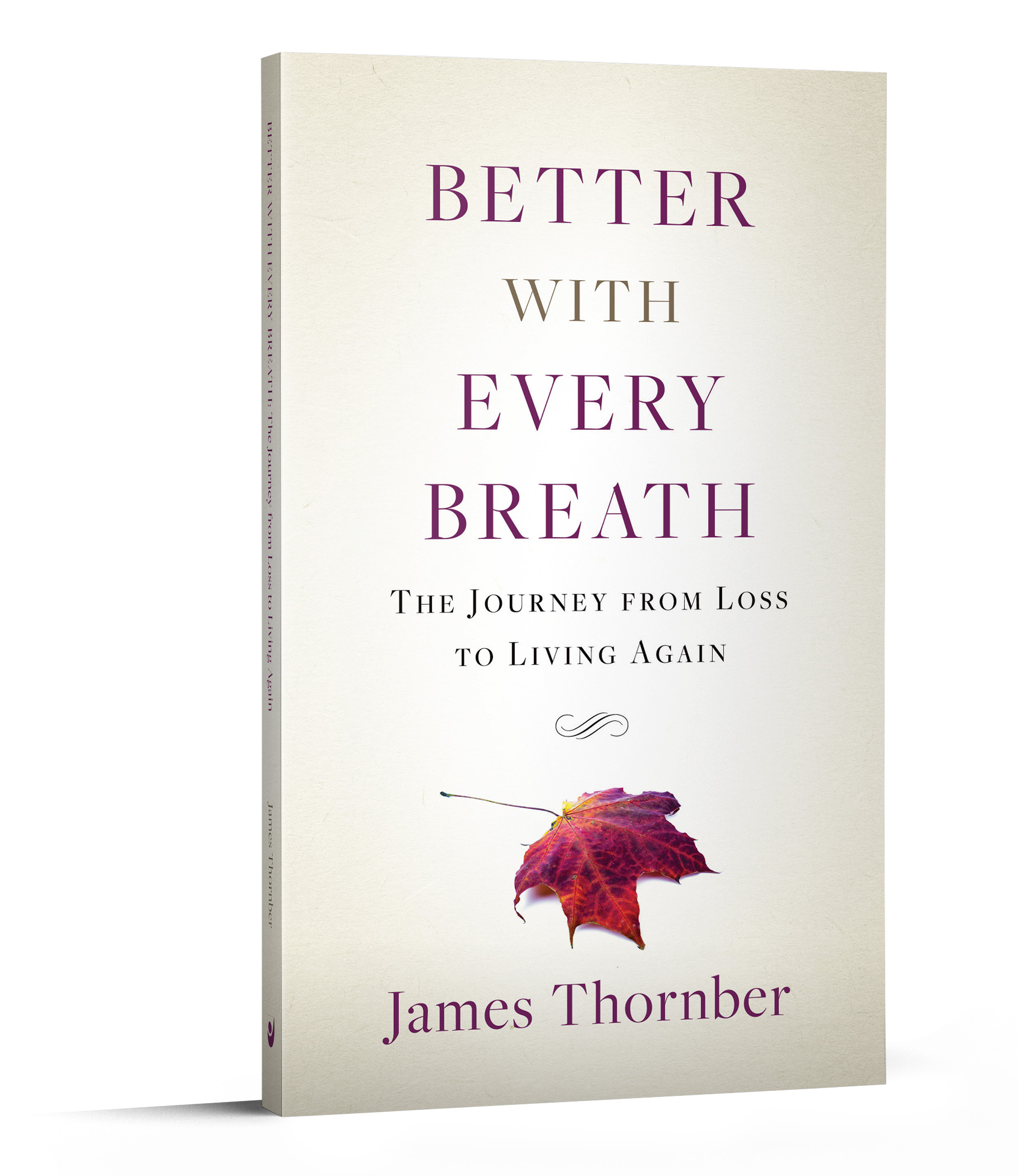
If you have recently lost a spouse, a parent, or a child, or know someone who has, I encourage you to read my book, Better with Every Breath. Written in the first sixty days after I lost Barbara, it shows you how I chose gratitude as my response to the inevitable in life: losing a loved one. I chose to thank God for the time we had and not be angry for the time we did not.

No Wishing Allowed

Posted by Jim Thornber on May 27, 2021
Posted in: Christian Spirituality. Tagged: Faith, Family, God, Grief, Marriage. Leave a comment

I originally published this in July, 2017, but with Barbara’s passing last September, I wanted to share this again as an encouragement for those who are married and for those who hope to be one day.

Not too long after Barbara and I were married, we cooked our first Thanksgiving turkey. It wasn’t too bad for a first time effort, and, although I really don’t remember it, I’m sure the whole meal was a joy. I do remember, however, that after I carved the turkey I did the traditional thing and set the wishbone aside to dry on the windowsill in the kitchen.

After a few weeks we decided the wishbone was ready to be tested. Barbara took one end and I took another. After making our “wishes,” we pulled at the wishbone, only to have it split evenly right up the middle. No winners. No losers. Just us, still the same. We looked at each other, then at the pieces of bone in our hands, then back at each other and nervously laughed.

I don’t often get weirdly spiritual, as in looking for God trying to get my attention behind every strange happening or offbeat coincidence. Still, Barbara and I knew immediately what the Lord was saying, and we haven’t shared a wishbone since. Not once. So, if you think we are weird spiritual fanatics, at least we are weird together and we don’t have only one of us taking all the blame.

From this simple incident we learned two valuable lessons. First, the success of our marriage has nothing to do with luck and even less to do with wishing. There is nothing superstitious, coincidental, fortuitous or haphazard about a successful marriage. A strong, committed relationship is a choice we make, everyday, for the rest of our lives. Furthermore, I didn’t get “lucky” finding Barbara. My first priority was to follow God’s direction in my life, not find a wife. With that priority set, God brought the right woman into my life. Luck is not a factor when God is placed first.

Second, Barbara and I are not in competition. I do not “win” when she “loses.” I am not the better person if my wishes come true over those of my wife. There are plenty of good thing’s in life to go around without thinking my fortune must come at someone else’s misfortune. Unless we are in a heated game of Scrabble, I am not in competition with Barbara. And even in Scrabble, we cheer the other if they make a high score. I didn’t get married to compete with and overcome my best friend. Her success is my success.

Because I believe this, it bothers me to watch couples take delight in putting the other one down in public. If a guy does this to his wife, I’m thinking, “If she is so stupid and ignorant, why did you take public vows telling the world you wanted to spend the rest of your life with her? Who’s the real idiot in this scene?”

Ephesians reminds men to “love your wives, just as Christ loves the church” (Eph. 5:25). Not once has anyone ever heard Jesus point to one of His Bride and say, “Why are you so dumb? He Mike and Gabriel, come look at what stupid thing this one did just now.” Jesus treats His Church better than that, and so should we. Even if they are not our spouse. But especially if they are.

So, this Thanksgiving when someone wants to make a wish over a piece of bone, kindly look at them and say, “Tell you what. How ’bout we both pray good things for one another, because your success is my success.”

If you are interested in reading my book about loss, grief and my decision to choose gratitude before Barbara passed, you can now buy my book at your favorite bookseller.

This Is NOT My Money

Posted by Jim Thornber on May 4, 2021
Posted in: Christian Spirituality, Publishing, Religion, Scripture. Tagged: God, Grief, Money, Publishing, Scripture. 2 Comments

“Everything we have has come from you, and we give you only what you first gave us!” – 1 Chronicles 29:14

          Have you ever thrown yourself a pity party and you didn’t invite anyone except yourself? I did just that last month, but instead of being alone, the Lord took pity on me and showed up anyway. And I’m very grateful He did.

            Forty days after my wife Barbara died on September 12, 2020, I started writing a book called Better with Every Breath: The Journey from Loss to Living Again. This book tells how I chose to express gratitude to God in the midst of a devastating loss. Because I’m not a well-known name in Christian circles, I self-published my book with HigherLife Publishing, the same company that published my first book, Taking Off My Comfortable Clothes. Friends and colleagues encouraged me to write even when I didn’t think I had it within me to do so. But nineteen days later I had a rough draft and in March, I received my copies from my publisher.

About the time my books arrived at my house, a couple whose wedding I did invited me to their home for dinner on Saturday evening. They asked if I would bring a copy of my book and play some boogie-woogie piano for grandma. Of course I said yes, (dinner was tomahawk rib eye and lobster tail!), and we had a wonderful time.

            Three days later, I was alone in the back of Woods Lumber where I work during the week. As I was checking in some freight, I started my pity party.

            “Lord,” I said, “I wonder if I did I do the right thing. This book cost me a lot of time and money. I know I’ve only had the books for less than a week, and it won’t release from Amazon for another two months, but did I do the right thing? Was it worth it?”

            Not three seconds later, the man who invited me to dinner came into the back room at Woods Lumber looking for me. He’s a tall man from Texas and speaks with that wonderful, slow drawl. He looked at me through misty eyes and said, “I just wanted to thank you for coming to our house Saturday night and bringing you book. We’ve already read it and cried. And thank you for playing piano for grandma. I just wanted you to know I appreciate you and I consider you one of my best friends.” Then, with tears in his eyes, he shook my hand and left.

            As I stood there a bit stunned and speechless, the Lord interrupted my pity party and spoke this to my heart: “Who are you to tell Me how I should spend My money?”

            Now I was speechless twice.

            The business world will tell us to always be aware of the ROI, the Return On Investment. The ROI measures the efficiency or profitability of an investment. If I invest X amount of dollars, will I get X+ in return? Will I get my money back and then some?

            But God works from a completely different economic model than the one Wall Street uses, which I discovered in the back room at WoodsLumber. God was reminding me how He was leading me to invest His money in His people, for He was not looking for a monetary ROI, but a spiritual one.

               I’m grateful the Lord has chosen to use my story to touch the lives of His people, and I’m glad King David reminds me that everything I have comes from God. Besides, isn’t it always easier to spend someone else’s money than it is to spend your own?

Comfort Is Not The Agenda

Posted by Jim Thornber on November 23, 2020
Posted in: Christian Spirituality. Tagged: Faith, God, Jesus, Loss, Spouse. Leave a comment

One of the criminals hanging beside him scoffed, “So you’re the Messiah, are you? Prove it by saving yourself—and us, too, while you’re at it!” (Luke 23:39)

One of the highlights of my week is meeting with pastors from other churches for coffee on Friday mornings. There is no plan or schedule to these meetings other than friendship, but we also gather knowing we have a unique position in our town and only other pastors will understand our victories and struggles.

A couple of weeks ago, one of the pastors referenced the thief on the cross who scoffed at Jesus, saying, “So you’re the Messiah, are you? Prove it by saving yourself—and us, too, while you’re at it!” After he quoted the thief I said, “And here we are today, still trying to tell God how to be God!”

As soon as I said this it struck me how often I have done the same thing as the thief. “If you were really THIS kind of God,” I would think, “then you would do THIS for me.” And, of course, this makes me a thief who is trying to steal the true character of God and replace it with a god of my making.  

It’s a good thing our society no longer hangs thieves.

If anyone is wondering, I have plenty of suggestions on how God can make me comfortable and answer my prayers. But then, I think about Jesus. As He hung upon the cross, Jesus wasn’t concerned with His comfort. Instead, He was concerned with obeying God’s agenda for His life.

Furthermore, it’s easy for me to admit I’ve lived a comfortable life. I’ve never known the type of suffering that took place in Europe during World War II. I’ve never battled cancer or been kidnapped. I’ve never faced homelessness or starvation, never been in a car crash or lost a limb in an accident, and for those things I am grateful.

The worst pain I have ever experienced is the loss of my wife, Barbara, who died on September 12, 2020 from complications of COVID-19. I can find no words that adequately describe the pain of losing a soul mate, a best friend, the one God created to be my equal in life.

Still, I trust God will continue to work in my life as I go forward, the same way He worked in our life as I look back at the amazing twenty-six years I had with Barbara.    

After years of wanting God to fulfill my will, I’ve finally come to accept that God’s agenda for my life is not to make me comfortable, but to help conform me into the image of Christ (Rom. 8:29). Therefore, I cannot honestly say, “LORD, your will be done in me,” then complain when His will makes me uncomfortable.

Losing a spouse is devastating, but losing my perspective on God’s magnificent goodness and love would be worse. Therefore, I’ve decided keep these words of Habakkuk constantly on my mind: “Yet I will rejoice in the LORD! I will be joyful in the God of my salvation! The Sovereign LORD is my strength!” (Hab. 3:18-19).

Although I am still mourning, I mourn with hope, and “hope does not disappoint” (Romans 5:5). Instead, hope brings me the comfort only God can provide in a season of tremendous loss, for now I truly understand the Sovereign Lord is my strength.

Going Where Others Cannot

Posted by Jim Thornber on October 22, 2020
Posted in: Christian Spirituality. Tagged: Christian Spirituality, Faith, Friendship, Jesus. 2 Comments

“As evening came, Jesus said to his disciples, ‘Let’s cross to the other side of the lake. So they took Jesus in the boat and started out, leaving the crowds behind (although other boats followed). (Mark 4:35-36)

            Many people I know can look back at their lives and wonder what happened to that friend who was so important to them at one time, and now they are no longer part of their life. Me, too. Then I read this passage in Mark and I began to understand.      

            In this story we see Jesus telling His disciples to row Him across the Sea of Galilee. Perhaps they had an idea they were headed to Gentile territory, but they certainly didn’t know they would visit burial caves and witness Jesus heal a man who had a legion of demons living in him.

            But that’s not my point. What interests me in this passage is the way other boats followed, but we have no record of those people getting out of their boats and accompanying Jesus to the cemetery. And from what I can see, there was nothing preventing them from going onshore with Jesus. I believe this teaches us an important and comforting lesson: Not everyone who says they are a follower of Jesus is willing to go where Jesus is leading you.

When I was in Bible College, I had a friend who was very instrumental in my life. He was older than I was and raised in a Christian home—an advantage I did not have. I depended upon his experience with the Lord, his wisdom regarding the ways of the world and his godly counsel. He was one of the few people who wholeheartedly supported my decision to leave Southern California and join a monastery in Eureka Springs, AR. Later when I was praying about marrying Barbara, he was one of the friends I relied upon to guide my thinking and help me understand what I going to face as a married man. He said, “She loves you. Marry her.” And I did.

            Shortly after I started my Master’s degree, this friend stopped being my friend. He cut off all communication with me and wouldn’t talk to Barbara or me. Eventually, he left his wife and started his life over in another part of the country.

            This has bothered me for many years. Every few years he will text me or send an email, but fifteen years later, he still will not talk to me. I respect his decision and do not try to contact him. His ex-wife tells me what he thinks of me, but that’s all I know and all I need to know at this time. I finally came to understand that Jesus was leading Barbara and me in a direction—a direction this onetime friend was not willing to follow. He could no longer be my mentor and confident, because what I was going to experience as a disciple of Christ did not include him.

            This gives me a bit of comfort, knowing it may not have been anything I did, but something God did.

            Most of us can look back and wonder what happened to that important friend we once had. We remember it as a significant relationship, one we could see God’s hand orchestrating, supplying us with what we needed as a young Christian, guiding our thoughts and actions into a better understanding of God’s ways. Then slowly, or in my case, suddenly, that person is no longer there. God was calling us to a place others could not or would not follow.

Abraham experienced a similar situation as he prepared to obey God by sacrificing his only son Isaac. He told his servants, “Stay here with the donkey. The boy and I will travel a little farther. We will worship there, and then we will come right back.” (Gen. 22:5).

Neither my former friend nor the servants of Abraham were bad people. I believe my friend is still serving God in his own capacity; he’s just not doing that by my side, and that is okay. Conversely, perhaps God led my friend in a direction I could not follow.

I write this hoping it brings you some comfort and insight into your own former relationships. It took me a while, but I no longer carry the pain of a friendship that no longer exists. I choose to believe that what I had was what I needed, and now I no longer need what I had. “The Lord gave me what I had, and the Lord has taken it away. Praise the name of the Lord!” (Job 1:21).

Posts navigation

← Older Entries
  • My Book

    If you want to purchase a copy of my book, click the image.

    This book tells of the lessons I learned as an Assemblies of God minister who was also a monk. For four years I lived with the Brothers and Sister of Charity at the Little Portion Hermitage. I went there because I thought it was unique and would make my spiritual life comfortable. God showed me I had to take off my comfortable clothes and put on the clothes of Christ. You can click the image to learn more and purchase the book.

  • December 2025
    S M T W T F S
     123456
    78910111213
    14151617181920
    21222324252627
    28293031  
    « Apr    
  • Archives

    • April 2024
    • September 2023
    • October 2022
    • September 2021
    • August 2021
    • July 2021
    • May 2021
    • November 2020
    • October 2020
    • September 2020
    • July 2020
    • June 2020
    • March 2020
    • February 2020
    • December 2019
    • November 2019
    • August 2019
    • July 2019
    • June 2019
    • February 2019
    • December 2018
    • October 2018
    • September 2018
    • August 2018
    • July 2018
    • June 2018
    • May 2018
    • April 2018
    • March 2018
    • December 2017
    • November 2017
    • October 2017
    • August 2017
    • July 2017
    • June 2017
    • May 2017
    • April 2017
    • March 2017
    • February 2017
    • January 2017
    • December 2016
    • November 2016
    • September 2016
    • August 2016
    • July 2016
    • June 2016
    • May 2016
    • April 2016
    • March 2016
    • February 2016
    • December 2015
    • November 2015
    • September 2015
    • August 2015
    • July 2015
    • June 2015
    • May 2015
    • April 2015
    • March 2015
    • February 2015
    • January 2015
    • December 2014
    • November 2014
    • October 2014
    • September 2014
    • August 2014
    • July 2014
    • June 2014
    • May 2014
    • April 2014
    • March 2014
    • February 2014
    • January 2014
    • December 2013
    • November 2013
    • October 2013
    • September 2013
    • August 2013
    • July 2013
    • June 2013
    • May 2013
    • April 2013
    • March 2013
    • February 2013
    • January 2013
    • December 2012
    • November 2012
    • October 2012
    • September 2012
    • August 2012
    • July 2012
    • June 2012
    • May 2012
    • April 2012
    • March 2012
    • February 2012
    • January 2012
    • December 2011
    • November 2011
    • October 2011
    • September 2011
    • August 2011
    • July 2011
    • June 2011
    • May 2011
    • April 2011
    • March 2011
    • February 2011
    • January 2011
    • December 2010
    • November 2010
    • October 2010
    • September 2010
    • August 2010
    • July 2010
    • June 2010
    • May 2010
    • April 2010
    • March 2010
    • February 2010
    • January 2010
    • December 2009
    • November 2009
    • October 2009
    • September 2009
    • August 2009
    • July 2009
    • June 2009
    • May 2009
    • April 2009
    • March 2009
    • February 2009
    • January 2009
    • December 2008
    • November 2008
    • October 2008
  • Blogroll

    • Archie
    • bbgcmac
    • Bellissimanh
    • Beth Sciallo
    • Brothers And Sisters of Charity
    • George Cannon
    • internet monk
    • Kin Robles
    • natalie spera
  • Recent Posts

    • An Abundance to Give
    • Why Jesus Christ Is NOT My Personal Lord and Savior
    • Thank You For Saying, “Thank You”
    • The Day My Grandmother Talked To Me About Sex
    • A Lesson in Love
  • Recent Comments

    Henry Andrews's avatarHenry Andrews on Our Four-Minute Fling in First…
    Jim Thornber's avatarJim Thornber on Scriptures That Bother Me…
    Nicole's avatarNicole on Scriptures That Bother Me…
    Eva's avatarEva on When God is Silent
    Rosemary Q's avatarRosemary Q on A Poor Widow’s Rich Offer…
  • Pages

    • About
    • How I became a monk
    • My Book
  • RSS Thinking Out Loud

    • An Abundance to Give
    • Why Jesus Christ Is NOT My Personal Lord and Savior
    • Thank You For Saying, “Thank You”
    • The Day My Grandmother Talked To Me About Sex
    • A Lesson in Love
    • God Doesn’t Owe Me An Apology
    • No Wishing Allowed
    • This Is NOT My Money
    • Comfort Is Not The Agenda
    • Going Where Others Cannot
  • Abraham alone Apostle Paul Assemblies of God Blood Brothers and Sisters of Charity Calvary Cancer Catholic Catholicism Cats Character Christianity Christian Spirituality Christmas Church Colossians Community Living Compassion Confession Death Demons Disciples Divorce Ecumenism Exodus Faith Forgiveness Galatians Genesis Gifts Giving God Gratitude Heaven Hebrews International Pentecostal Holiness Church James Jesus Job John Michael Talbot Joy Leadership Little Portion Love Luke Mark Twain Marriage Mary Matthew Miracles monasticism Money Monk Moses Music Noah Obedience Oswald Chambers Pastor prayer Prodigal Son Publishing Religion Romans Salvation Savior Scripture Service Soccer Solomon Spiritual Gifts Spirituality Worship Writing
  • Top Posts

    • Scriptures That Bother Me -- Matthew 14:28-30
    • The Day My Grandmother Talked To Me About Sex
    • Scriptures That Bother Me -- 2 Chronicles 32:31
    • Scriptures That Bother Me -- Deuteronomy 8:10
    • Scriptures That Bother Me -- Luke 2:36-37
  • Meta

    • Create account
    • Log in
    • Entries feed
    • Comments feed
    • WordPress.com
Create a free website or blog at WordPress.com.
Thinking Out Loud
Blog at WordPress.com.
Privacy & Cookies: This site uses cookies. By continuing to use this website, you agree to their use.
To find out more, including how to control cookies, see here: Cookie Policy
  • Subscribe Subscribed
    • Thinking Out Loud
    • Join 260 other subscribers
    • Already have a WordPress.com account? Log in now.
    • Thinking Out Loud
    • Subscribe Subscribed
    • Sign up
    • Log in
    • Report this content
    • View site in Reader
    • Manage subscriptions
    • Collapse this bar
 

Loading Comments...