
By faith Abraham, when called to go to a place he would later receive as his inheritance, obeyed and went, even though he did not know where he was going. Hebrews 11:8
 Abraham’s patient obedience is starting to irk me. He did not own any land, nor had he personally received any as an inheritance, but lived as a tent dwelling nomad, moving from place to place. He waited twenty-five years to see the son God promised him, and never really possessed the land God said his children would inherit.
I keep wondering how Abraham could remain so patient in his obedience. We live in a society that grows impatient if it takes too long for the coffee to brew in the morning, much less wait four hundred years for escrow to close on our new property. Still, Abraham went to Canaan possessing nothing but faith. He didn’t know where he was going, didn’t have a house when he arrived, didn’t own any land to build upon and didn’t know anybody who lived there. It kinda makes you wonder why he would go in the first place.
However, Abraham “when called . . . obeyed and went” (vs. 8). The phrase “when called” translates an action indicating a quick response. In other words, while the call of God was still ringing in his ears, Abraham was packing his bags and moving west.
When was the last time I obeyed the word of God while the sound of His instruction was still ringing in my ears? Continue Reading

 Last Wednesday, Barbara and I were co-teaching the book of James to a small group. After spending an hour talking about the book, we barely finished James 1:2, which tells us to consider it an opportunity for great joy when troubles come our way. Doesn’t that sound easy and fun?
 A few years ago, a church I attended in Arkansas hosted a Thanksgiving service, which served to raise money for the ministerial alliance. The alliance asked our church to lead in the praise and worship, and I played the piano on the worship team. Looking over the congregation, I noted a pastor from another church who, no matter what we sang, refused to either clap his hands or raise them in worship. He simply sat in his pew with his arms folded. That struck me as strange, because outside of church he was a happy, vivacious, demonstrative man.
 I like the honesty of King David. Up until verse sixteen of Psalm 139, David is contemplating ways he could hide from God. (I’ve done that – I just don’t readily admit it.)
 I’ve been around Christians and Christianity for thirty-five years now. I’ve been associated with Baptist, Pentecostal, Catholic and non-denominational organizations and churches. I’ve seen mysterious, authentic movements of God’s Spirit that have transformed people’s lives, and had conversations with pseudo-religious nuts who proclaimed they were the only ones who held true to “The One True Faith.” It’s been a wild ride.
 Perhaps the best-known passage that shows us the servant heart of Jesus is John 13, where we see our Lord and Savior, the creator through whom God made the universe, washing feet.
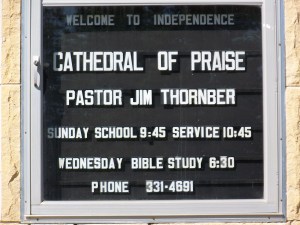 Look at that picture. Yep, that’s me. “Pastor” Jim Thornber. Even though I see the title, I truly do not comprehend the immensity of it all.
 Blaise Pascal said, “We must learn our limits. We are all something, but none of us are everything.” Or, as that wise 20th century philosopher Harry Callahan (Clint Eastwood) said in the movie Magnum Force, “A man’s got to know his limitations.”
 I had an interesting conversation this summer with a man at a church picnic. Because I had never met him, at first glance I thought he was going through chemotherapy. He wore a knit cap in ninety-degree weather, had no hair on his arms, legs or face, and had penciled in his eyebrows. Only after I sat across from him at lunch did I understand the situation.



 Thinking Out Loud